Raising finance through EIS and VCTs – a guide for companies


Updated: 
Authors: David Brookes

The Enterprise Investment Scheme (EIS) and Venture Capital Trusts (VCTs) help unquoted businesses raise equity finance by offering investors a range of tax incentives. The limits on how much can be raised through these schemes and qualifying criteria for companies were increased in the 2025 Budget, meaning that more companies will be able to make use of these schemes from April 2026. With the increased limits, meeting the qualifying criteria and time limits remains key. This is a guide for companies planning to use the schemes – if you are an investor, read more about the benefits to investors of EIS, SEIS and VCTs.

Note, the increases to the EIS limits do not apply to companies registered in Northern Ireland.

Our experts in equity finance help both companies and investor make full and proper use of the tax incentives. They would be delighted to talk to you about your plans under these schemes.

Speak to our experts
 

Investment limits

Investment limits have been doubled from April 2026. 

A company can raise up to £24m over its lifetime, or £40m if it is a knowledge intensive company (KIC), from a combination of EIS and Seed EIS investors, VCTs and other forms of state aid risk capital. A company cannot raise more than £10m in any one 12-month period (£20m for KICs). 

Qualifying companies

The qualifying criteria for companies have been doubled from April 2026. 

Companies must satisfy a number of requirements to qualify to use the EIS and VCT schemes at the time of the share issue and for the following three years. 

When the shares are issued, the company must: 

  • Have gross assets of less than £30m and no more than £35m immediately after the EIS/VCT share issue
  • Have fewer than 500 'full time equivalent' (FTE) employees, or 500 FTE if it is a KIC
  • Be unquoted or on AIM, and have no arrangements to become quoted on a recognised stock exchange
  • Raise no more than £10m per year per group from a combination of the EIS, SEIS and VCTs (£20m for KICs)
  • Raise no more than £24m (£40m if a KIC) in total per group over their lifetime from a combination of the EIS, SEIS and VCTs
  • At the time of the share issue and for three years after the share issue, the company must:
    • Be independent; not under the control of another company
    • Be trading or preparing to trade – though certain types of trade are prohibited. See 'Excluded companies' below
    • Having a UK 'permanent establishment', trading mainly in the UK, is no longer a requirement.

There are also anti-avoidance rules to counter pre-arranged exits and any arrangements designed to reduce an investor’s risk. 

Finally, all money raised from the issue of EIS and VCT shares must be used to grow and develop the business. It must not be used to make acquisitions of another company’s shares, trade or certain types of trading asset. 

Smaller companies may prefer to raise funds via SEIS, rather than EIS or VCT.  

Rules for qualifying company 

EIS and VCTs are designed to encourage investment in higher risk companies. Companies for which 20% of their trade is in the following activities are excluded from the schemes. These activities that can exclude companies are: 

  • Dealing in land, shares, futures and other financial instruments
  • Dealing in goods other than in the normal course of a retail or wholesale trade
  • Banking, insurance, money lending or other financial activities
  • Leasing or receiving royalties or license fees, unless the company has created the intangible asset itself
  • Providing legal or accountancy services
  • Farming, market gardening, woodlands and timber production.
  • Property development
  • Hotels and nursing homes
  • The generation or production of heat, electricity, power, fuel or gas
  • Coal and steel production, shipbuilding
  • Providing services to a connected party conducting one of the above trades.
Qualifying investors

The company must ensure that their investors using the EIS and VCT schemes meet certain criteria. A stated aim of the EIS is to attract outside investors to companies. As a result, the scheme denies EIS relief to investors who are ‘connected’ with the company. This includes: 

  • Employees or directors of the company
  • Investors who, together with their ‘associates’, hold more than 30 per cent of the company’s share capital. Associates include business partners, spouses, lineal relatives, but not siblings
  • Existing shareholders whose shares are not SEIS or EIS qualifying, or subscriber shares
  • There are provisions for ‘Business Angels’, enabling certain investors to become directors

The seven-year rule

The first seven years (ten years if a KIC) after a company makes its first commercial sale is known as the ‘initial investing period’. A company that did not issue EIS, SEIS or VCT shares in its ‘initial investing period’ is excluded from EIS investment unless it raises EIS/VCT money amounting to at least 50% of its five-year average turnover. The company must also spend that money on entering a new product or geographic market. 

Qualifying shares

The shares subscribed for must be full risk, newly issued ordinary shares or non-cumulative, fixed preference shares. No linked loans are allowed and there can be no protection offered to shield investors from risk. They must be subscribed for in cash and fully paid up at time of issue. 

EIS qualifying status – EIS1 and EIS3

Many potential investors will want some form of comfort that their investment will qualify for the EIS tax reliefs. 

It is possible, and recommended, to obtain ‘advance assurance’ from HMRC before issuing shares to investors. Advance assurance is not a requirement of the EIS and does not guarantee that a share issue will qualify. However, it is useful both in attracting investors and in resolving any potential issues before it is too late. Many potential investors will insist on advance assurance. 

Once shares have been issued and the Company has traded for four months, the Company makes a declaration on an ‘EIS1’ form, providing details of the investors to HMRC. If HMRC approve, the company will be authorised to issue the ‘EIS3’ certificate to investors which enables them to claim their tax reliefs. 

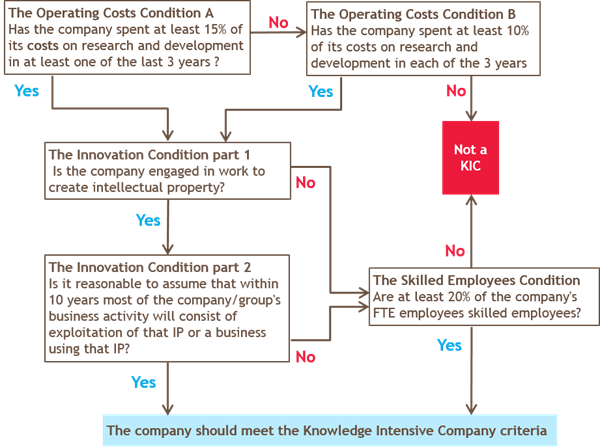
Knowledge Intensive Companies (KIC) limits doubled from April 2026.

A KIC can raise up to £20m in a single year and £40m in total state aid investment. KICs also benefit from a 10-year ‘initial investing period’. In addition, KICs can choose to date themselves from the end of the accounting period in which their turnover first reached £200k per year, rather than from their first commercial sale. 

An EIS investor can normally only invest up to £1m in EIS qualifying companies in any tax year. Provided they invest at least £1m in KICs, they can now obtain EIS relief on up to £2m. 

Broadly, if a company invests in research and development (R&D) and derives, or will derive its revenues, from that R&D, it is likely to qualify as a KIC. 

EIS and VCTs

How we can help companies with EIS and VCT

We can help your company attract equity investment by guiding you through the minefield of tax legislation, helping you obtain advance assurance from HM Revenue & Customs and dealing with the compliance side of the process. 

If you would like to discuss raising equity finance through EIS or VCT, we would be delighted to hear from you - get in touch with the team today.

CONTACT US

Authors

David Brookes
Tax Partner / Lead Partner Reading and Bristol offices

Contact us

Please refer to the Introduction to our Privacy Statement and the Contacts section, which tell you what we do with your personal information, your rights and other relevant information.